When a Metaphor Becomes a Political Argument
See how political metaphors turn abstract ideas into familiar scenes, steer public judgement and reveal what a persuasive comparison leaves out.
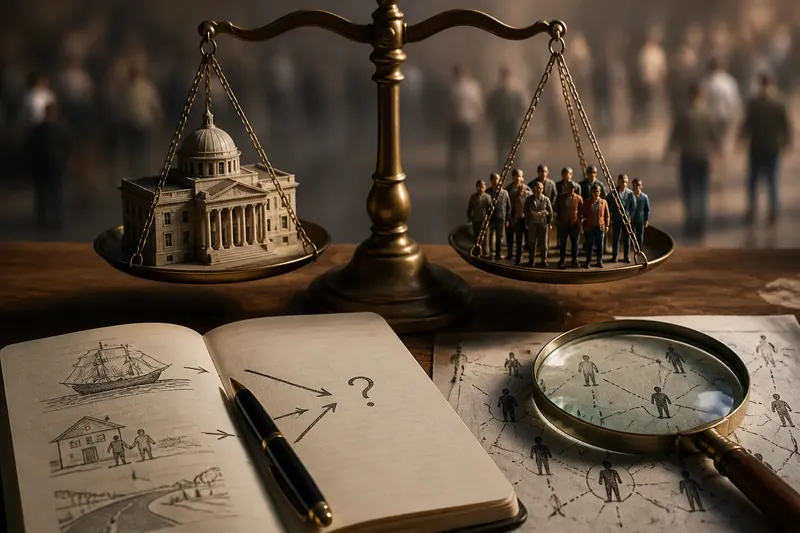
The common mistake with a political metaphor is to treat it as decoration. In a debate about public spending, calling a budget a “household purse” can make restraint feel like common sense before anyone has explained what the budget funds or how public finance works. The comparison is already making an argument: it imports a familiar scene, with its habits and assumptions, into a question that may operate by different rules.
Metaphors have served public rhetoric for centuries because they give difficult ideas a shape people can grasp. Their force lies not only in making an abstraction vivid, but in directing attention towards some features and away from others. Read one closely by asking what the comparison helps us see, what it asks us to accept and where it stops fitting.
A metaphor gives an abstraction a familiar shape
A political idea such as sovereignty, reform or social responsibility can be hard to picture. A metaphor offers an object, place or action as a mental handle. A government may be described as a ship, a community as a family, or a political movement as a wave. The listener can then reason about the unfamiliar subject through the familiar one.
This is more than a shortcut in explanation. A ship has a destination, a crew and a person at the helm. Once government is cast as a ship, questions about direction and leadership seem natural. Other questions—who chose the destination, who is allowed aboard, or whether the vessel is the right model at all—may receive less attention.
So ask what a metaphor makes easier to think about, not only whether it is vivid. A comparison that brings a distant policy into view can also narrow the field, like a torch lighting one corner of a room while leaving the rest in shadow.
Familiar comparisons carry old assumptions into new arguments
Metaphors rarely arrive without baggage. They draw on shared habits and stories, including assumptions the speaker may never state. Calling a nation a family, for instance, can suggest mutual obligation and belonging. It can also suggest a single head of household, obedience and a sharp boundary between relatives and outsiders.
The political effect depends on which part of the comparison becomes active. One listener may hear care; another may hear control. Neither response comes from the word alone. It also depends on cultural associations and the issue under discussion.
Repeated metaphors can become familiar frames that people use without reconsidering their assumptions. Ask who is given a role in the comparison and who is left outside it. If a policy is described as a “rescue”, find out who is portrayed as rescuing whom, from what danger and at whose discretion.
A vivid metaphor can imply causes and responsibility
Many comparisons do more than name an issue; they suggest how it works. Describing a social problem as a “leak” suggests something escaping from a container and that the task is to find and seal the opening. Describing the same problem as a “bottleneck” suggests congestion and a need to clear a route. Each image points towards a different diagnosis and, by implication, a different kind of remedy.
This can be useful when an image exposes a feature that abstract language obscures. But a metaphor is not a full explanation of a system. A leak may imply a simple boundary and a repairable fault, while a public problem may involve competing interests, uneven effects and decisions about what should be provided. The image can make one causal story feel obvious before that story has been stated.
Translate the metaphor back into plain language. Replace “the system is broken” with a statement of what is happening, to whom and through which decisions. Then check whether the proposed remedy follows from those details or only from the image. This separates a persuasive picture from an account of causes.
Historical metaphors can become political tools
Political speakers have long used images of the body, household, road and machine to make collective arrangements intelligible. Their persistence shows how readily an image can become part of the vocabulary used to discuss authority and community.
But a metaphor’s history does not make it a reliable guide. Familiarity can lend it an air of inevitability. If a political order is repeatedly described as a natural body, for instance, disagreement may be cast as illness rather than as a dispute about power or priorities. The image can make an arrangement seem organic, even when it is maintained by choices that could be debated.
When a metaphor appears to have a settled public meaning, examine how it is being used in the particular argument. Is it describing a relationship, praising a policy, assigning blame or making an alternative sound dangerous? Its history offers clues to its associations, not a substitute for reading the argument in front of you.
Map what the metaphor includes and leaves outside
To inspect a comparison, identify the political subject, the familiar source image and the qualities transferred from one to the other. Then look for mismatches. A road metaphor makes progress and direction easy to discuss, while saying little about who built the road, who pays for it or whether everyone can use it.
- Check the subject. If the political question is clearly named, identify the specific claim; if it is vague, ask the speaker to state the issue in plain terms.
- Check the image. If it is a machine, journey, family, market, contest or natural force, note the associations it brings; if the image is unclear, ask what familiar situation it is meant to evoke.
- Check the transferred qualities. If the speaker implies a particular behaviour or relationship, name it; if no quality can be identified, treat the comparison as atmosphere rather than explanation.
- Check who has a role. If some people appear as actors while others become scenery or a problem to manage, ask how the absent group’s perspective affects the claim; if no one is omitted, move on to the comparison’s other limits.
- Check the boundary. If the real issue works differently from the image, set the metaphor aside and describe the difference; if it fits the point being made, still ask what evidence supports the claim.
- Check the remedy. If the proposed action follows only from the image, ask for the reasoning in plain language; if the speaker gives a separate rationale, assess that rationale on its own terms.
Say you hear a local proposal described as “planting seeds for the future”. Imagine the proposal’s stated starting point is a plan to add a community garden to an unused patch beside a library; those details are invented for this example. First, identify the claim: the garden is expected to benefit local residents later. Next, ask what actions the proposal contains: preparing the ground, choosing what to grow and deciding who can use the space. Then ask how those actions support the promised outcome. If the speaker cannot explain that link, the phrase remains an appealing image but the claim needs more detail; if the link is explained, listeners can assess the proposal without relying on the metaphor alone.
How can readers assess a political metaphor?
Does a metaphor make an argument true?
No. It may help an audience picture a claim, but vividness is not evidence that the claim is accurate. Treat the image as a prompt to ask which concrete events, decisions or relationships it represents.
Can the same metaphor support opposing arguments?
Yes. A “journey” can suggest steady progress to one speaker and a wrong turn to another. Ask which direction, destination and travellers each speaker has in mind before comparing their conclusions.
How can I challenge a metaphor without getting stuck on wording?
Restate the political claim in plain terms, then ask whether its reasoning still holds without the image. This keeps discussion on the policy or relationship rather than on whether the phrase sounds appealing.
Should public speakers avoid metaphors?
No. A well-chosen image can clarify an unfamiliar idea and help an audience remember it. Speakers should make its limits clear when it might hide important differences or imply a solution they have not argued for.
A strong metaphor must survive scrutiny
For speakers, the test is not whether a comparison sounds memorable. Ask whether it clarifies the subject for listeners who do not already share your assumptions. If the image makes a policy easier to picture, follow it with the specific actions, responsibilities and consequences the image cannot supply.
For readers, listen for the moment a metaphor starts doing the work of a reason. Words such as “burden”, “engine”, “bridge” or “storm” may invite a judgement before the speaker has explained what is happening. Pause there. Name the image, state the claim without it and consider which people or choices have disappeared from view.
That habit does not strip political language of imagination. It lets a metaphor open a route into an abstract question without pretending to be the whole landscape. Notice a political metaphor especially when it feels so familiar that its argument has become hard to see.